- Home Page
- Company Profile
-
Our Products
- Cutting Machine
- Concrete Cutter Machine
- Plate Compactor
- Ring Making Machine
- Power Trowel
- Bending Machine
- Earth Rammer
- Straightening Machine
- Industrial Pump
- Road Roller
- Paver Machine
- Screed Vibrator
- Ride On Roller
- Truss Screed
- Batching Plant
- Vibratory Roller
- Threading Machine
- Construction Roller
- Pallet Truck
- Manual Stacker
- Bull Floater
- Concrete Mixer
- Suspended Platform
- Concrete Bucket
- Concrete Trolley
- Construction Hoist
- SCISSOR LIFT
- Contact Us

 Send Inquiry
SCISSOR LIFT
Price 35000 INR/ Unit
MOQ : 1 Unit
SCISSOR LIFT Specification
- Door Opening Size
- Customizable
- Type
- Stationary / Mobile
- Voltage
- 220V / 380V / 415V
- Inclination
- 0
- Machine Room Size
- Not Required / Integrated Type
- Hoist Way Size
- Standard: 2300mm x 1500mm, Customizable
- Pit Depth
- 150 mm - 250 mm
- Car Dimension
- Standard: 2000mm x 1200mm, Customizable
- Overhead Height
- 2000 mm (standard)
- Load Capacity
- 500-2000 kg (model dependent)
- Usage
- Material Handling, Warehouse, Loading Bays, Automotive
- Noise Level
- 65 dB
- Material
- Mild Steel / Stainless Steel / Aluminum Alloy
- Drive Type
- Hydraulic
- Power Supply
- Electric / Hydraulic
- Speed
- 3~5 m/min
- Max. Lifting Height
- 12 m
- Max. Lifting Weight
- 2000 kg
- Mechanism Type
- Hydraulic Scissor Mechanism
- Working Temperature
- -10C to +45C
- Control Device
- Push Button / Remote Control
- Safety Device
- Emergency Stop, Overload Protection, Safety Barriers
- Capacity
- 500 kg
- Lifting Time
- Approx. 30s-60s (full height)
- Installation
- Surface Mounted / Pit Mounted
- Operation Mode
- Manual / Semi-automatic / Fully-automatic
- Protection Grade
- IP54 Electrical Components
- Colour
- Industrial Yellow / Custom Paint Options
- Power Rating
- 2.2kW ~ 5.5kW (based on capacity)
- Platform Surface
- Anti-slip Checkered Plate
- Maintenance
- Low; Easily Accessible Parts
- Wheel Type
- Polyurethane / Optional
- Hydraulic Oil Specification
- 68# or as recommended
About SCISSOR LIFT
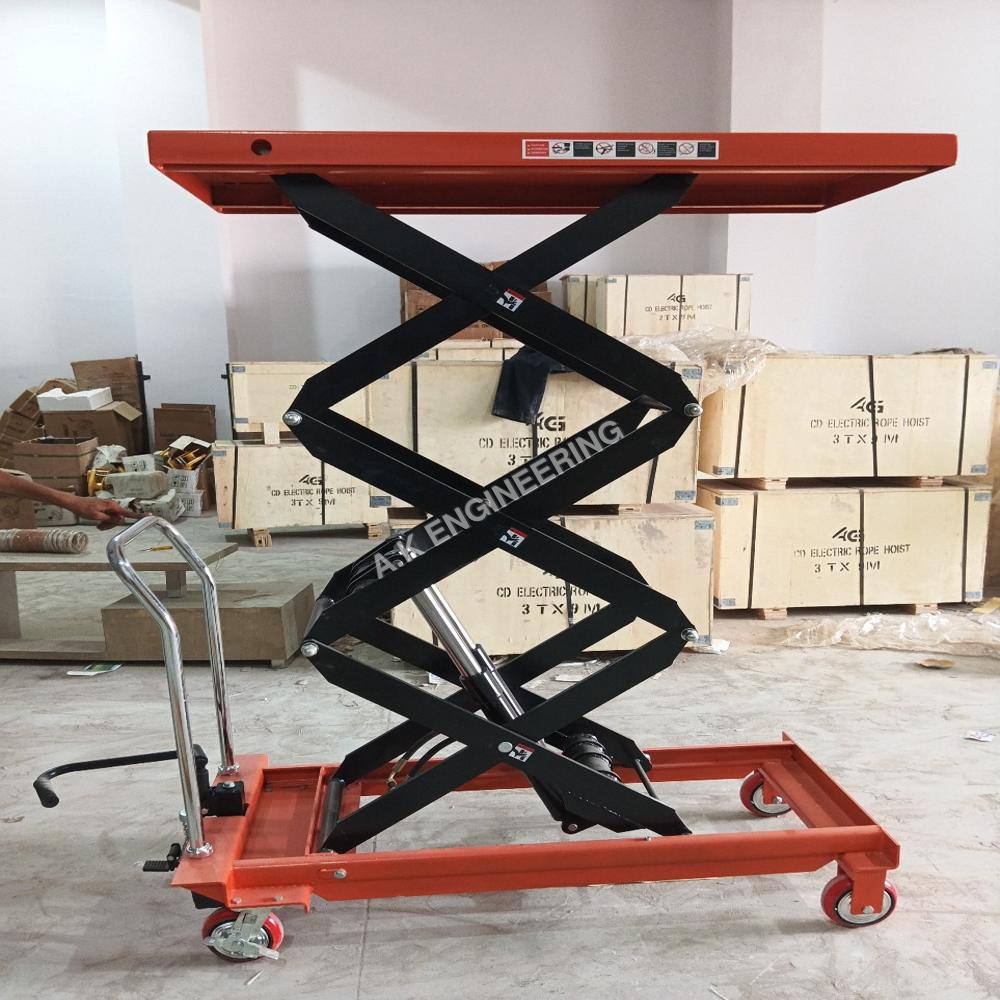
A scissor lift is a hydraulic or electrically powered lifting platform used to raise workers, tools, and materials vertically to perform tasks at elevated heights safely. It gets its name from the crisscross ("scissor) mechanism that extends and retracts to move the platform up and down.
Main Components
- Platform Working area where operators stand.
- Scissor Arms Interlinked metal supports that extend vertically.
- Hydraulic System Provides lifting force through hydraulic cylinders.
- Power Source Electric battery, diesel engine, or hydraulic motor.
- Base Frame Supports the machine and provides stability.
- Control Panel Used to operate lifting and lowering functions.
- Safety Guardrails Protect workers from falling.
Working Principle
When hydraulic pressure or electric power is applied, the scissor arms extend in a crisscross pattern, lifting the platform upward. Releasing pressure retracts the arms and lowers the platform safely.
Types of Scissor Lifts
- Electric Scissor Lift
- Quiet and emission-free
- Suitable for indoor use
- Diesel Scissor Lift
- Higher lifting capacity
- Used for outdoor and rough terrain applications
- Rough Terrain Scissor Lift
- Equipped with heavy-duty tires and stabilizers
- Suitable for uneven surfaces
Applications
Durable & Flexible Material Handling
Designed with industrial-grade materials such as mild steel, stainless steel, or aluminum alloy, the SCISSOR LIFT delivers superior strength and corrosion resistance. Its robust construction guarantees excellent performance in demanding environments and its flexibility allows installation on the surface or in a pit based on your facility layout.
Customizable Features for Your Needs
From platform dimensions to door opening sizes, the SCISSOR LIFT is configurable to match specific requirements. Choose your preferred color, wheel type, and operation mode-manual, semi-automatic, or fully automatic. This adaptability ensures optimal integration within diverse applications, enhancing efficiency and workflow.
Enhanced Safety and Simple Operation
The lift comes with multiple safety systems, including emergency stop, safety barriers, and overload protection. Operation is streamlined via push-button panels or remote control, reducing the complexity of lifting procedures. With easily accessible components and low maintenance needs, safety and reliability are at the forefront.
FAQ's of SCISSOR LIFT:
Q: How do you operate the SCISSOR LIFT, and what modes are available?
A: The SCISSOR LIFT can be operated using a push-button control panel or an optional remote control. Users can select between manual, semi-automatic, or fully automatic modes based on workflow requirements, ensuring maximum convenience and precision during lifting operations.Q: What are the primary benefits of using this lift for material handling?
A: This lift offers quick and secure vertical transportation of goods, lifting weights up to 2000 kg as needed. Its anti-slip platform, robust build, and advanced safety features reduce accident risk and facilitate efficient, smooth material movements within warehouses, loading bays, or automotive settings.Q: When is routine maintenance required, and how accessible are the parts?
A: The SCISSOR LIFT is engineered for low maintenance, with easily accessible parts that simplify inspections and repairs. Periodic checks, particularly of hydraulic oil and electrical components, are recommended in accordance with usage frequency to ensure optimal performance and longevity.Q: Where can the SCISSOR LIFT be installed, and what are the mounting options?
A: This lift can be surface mounted or pit mounted, offering flexibility for deployment in existing or new facilities. Its integrated machine room-less design allows for efficient use of space in warehouses, industrial plants, and loading zones.Q: What safety features are included to protect operators and loads?
A: The SCISSOR LIFT includes emergency stop functions, overload protection, and sturdy safety barriers. These systems are designed to minimize risks, safely manage heavy loads, and support secure operation, even during demanding usage.Q: What is the typical lifting speed and height range?
A: The lift achieves speeds of 3 to 5 meters per minute and can reach maximum lifting heights up to 12 meters. Full-height lifts are completed within approximately 30 to 60 seconds, optimizing workflow efficiency.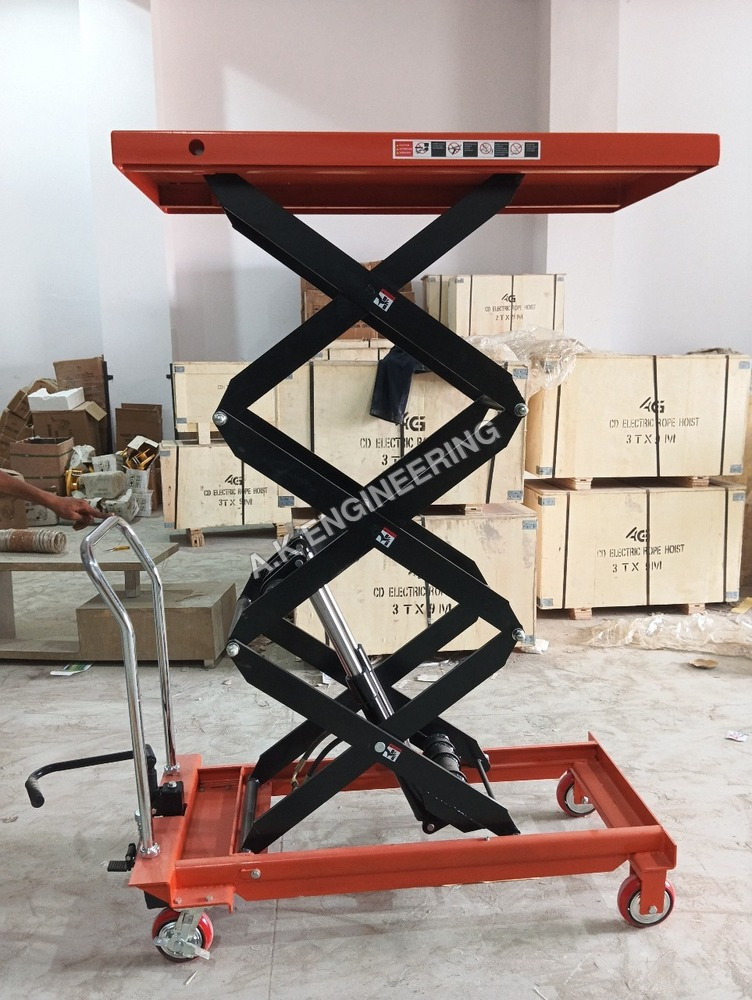
Tell us about your requirement

Price:
Quantity
Select Unit
- 50
- 100
- 200
- 250
- 500
- 1000+
Additional detail
Mobile number
Email

More Products in SCISSOR LIFT Category

Contact Us

- Flat No F/f-B, Plot at Kh No 31/1, Village Nangli Sakrawati, Najafgarh,New Delhi - 110043, India
- Phone : 08045813511

- Mrs Kiran Paswan (Proprietor)
- Mobile : 08045813511
- Send Inquiry
 Send Inquiry
Our Products
- Cutting Machine
- Concrete Cutter Machine
- Plate Compactor
- Ring Making Machine
- Power Trowel
- Bending Machine
- Earth Rammer
- Straightening Machine
- Industrial Pump
- Road Roller
- Paver Machine
- Screed Vibrator
- Ride On Roller
- Truss Screed
- Batching Plant
- Vibratory Roller
- Threading Machine
- Construction Roller
- Pallet Truck
- Manual Stacker
- Bull Floater
- Concrete Mixer
- Suspended Platform
- Concrete Bucket
- Concrete Trolley
- Construction Hoist
- SCISSOR LIFT
|



A.K ENGINEERING
All Rights Reserved.(Terms of Use)
Developed and Managed by Infocom Network Private Limited.
Developed and Managed by Infocom Network Private Limited.


